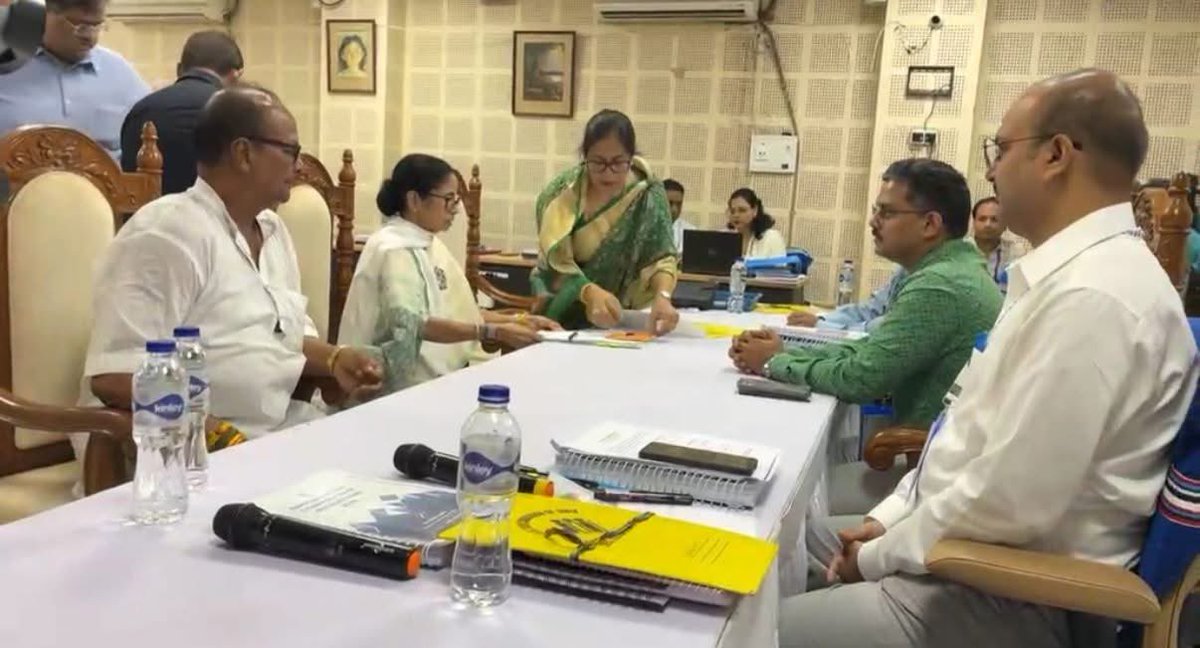
West Bengal Chief Minister Mamata Banerjee on Wednesday filed her nomination papers as the Trinamool Congress candidate from the Bhabanipur Assembly constituency, accompanied by a show of strength from party workers and supporters.
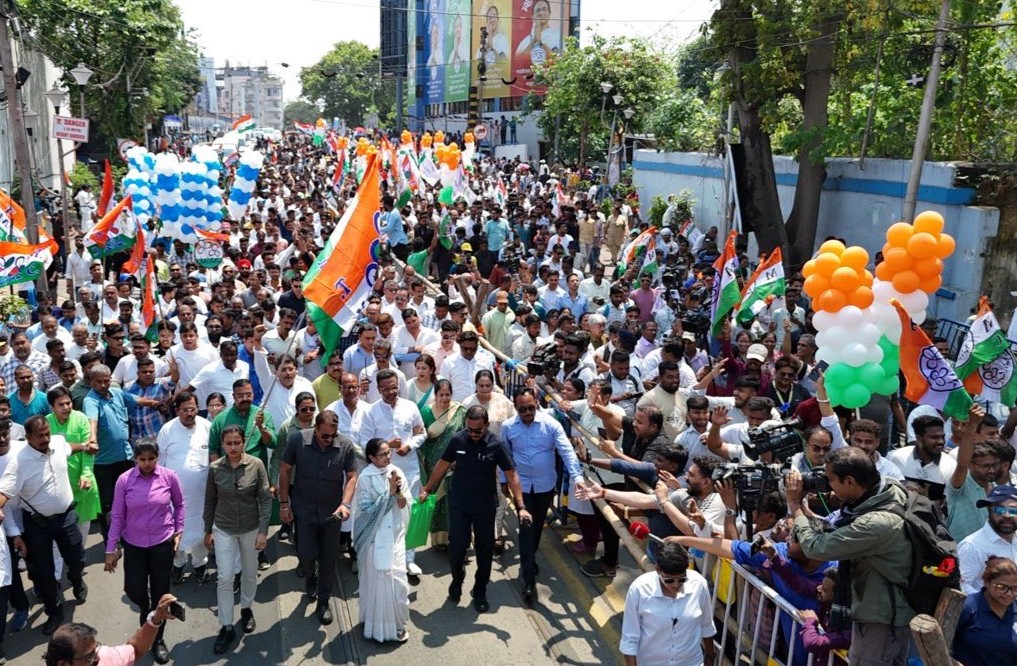
The Chief Minister began a roadshow from her Kalighat residence, making her way towards the Alipore Survey Building amid loud slogans and enthusiastic crowds. Supporters lined the streets in large numbers, cheering as she passed through the area.
Walking nearly 800 metres with folded hands and her characteristic smile, Banerjee acknowledged supporters gathered along both sides of the route before reaching the nomination centre, where she formally submitted her papers.
After filing her nomination, Banerjee said Bhabanipur holds personal significance for her. She stated that she was born and raised in the constituency and that her political journey began there. She also appealed to voters across all 294 Assembly seats to back Trinamool Congress candidates, expressing confidence of securing a stronger mandate than in previous elections. She was accompanied during the process by family members and close associates, including Firhad Hakim, Bablu Singh and Miraj Shah.
The Bhabanipur contest is expected to be closely watched, with Banerjee set to face Suvendu Adhikari of the Bharatiya Janata Party. The State will go to polls in two phases on April 23 and April 29, with counting scheduled for May 4.
As Mamata Banerjee seeks re-election, her political career spans more than four decades, marked by a steady rise from grassroots activism to becoming one of India’s most prominent regional leaders. Born on January 5, 1955, in Kolkata to a lower middle-class family, Banerjee grew up in modest circumstances following the early death of her father. She pursued her education at the University of Calcutta, earning degrees in History, Islamic History, Education and Law.
Banerjee began her political career with the Indian National Congress in the 1970s and quickly rose through its youth ranks. She gained national attention in 1984 after defeating veteran Communist leader Somnath Chatterjee from the Jadavpur Lok Sabha constituency, becoming one of the youngest Members of Parliament at the time. During her years in the Congress, she served multiple terms in Parliament and held key ministerial roles, including Minister of State for Human Resource Development, Youth Affairs and Sports, and Women and Child Development. She was known for her assertive political style and frequent confrontations with rivals.
In 1998, Mamata Banerjee broke away from the Congress to establish the All India Trinamool Congress, positioning it as the principal opposition force against the Left Front in West Bengal. She later joined the National Democratic Alliance and served as Railway Minister under Prime Minister Atal Bihari Vajpayee.
Banerjee held the Railway portfolio in multiple terms between 1999–2001 and 2009–2011. Her tenure focused on expanding connectivity to underserved regions, improving passenger amenities and introducing initiatives such as subsidised “Izzat” tickets for low-income travellers. Her railway budgets often prioritised affordability and regional development.
Her political ascent in West Bengal was closely tied to her leadership in major land acquisition protests, including the Singur agitation against the Tata Nano project and the Nandigram movement. These protests galvanised support among farmers and rural communities and significantly weakened the long-standing Left Front government.
In 2011, Banerjee led the Trinamool Congress to a decisive victory, ending 34 years of Left Front rule in the State. She became West Bengal’s first woman Chief Minister and has since retained power in the 2016 and 2021 Assembly elections.
As Chief Minister, Banerjee has introduced a range of welfare initiatives, including schemes such as Kanyashree, Rupashree, Lakshmir Bhandar, Sabuj Sathi, the Student Credit Card scheme and Swasthya Sathi. Her government has also focused on expanding rural infrastructure, improving urban development and promoting cultural activities and tourism.
Mamata Banerjee is known for her centralised leadership style and direct engagement with the public through rallies and outreach programmes. She has held multiple key portfolios, including Home and Health at different times. Her tenure, however, has also drawn criticism from opposition parties, including the BJP and Left, over allegations of political violence, suppression of dissent and concerns regarding law and order. The Trinamool Congress has consistently denied these charges, describing them as politically motivated.
Beyond the State, Banerjee has emerged as a significant opposition voice at the national level, often attempting to forge alliances among non-BJP parties. She is widely regarded as a key figure in broader opposition politics.
Known for her simple lifestyle, often seen in a plain white saree and slippers, Banerjee is also a published author and painter. Supporters describe her as a leader with strong grassroots connect, while critics view her as combative in style. As she files her nomination once again from Bhabanipur, Banerjee remains central to West Bengal’s political landscape, with her long career continuing to shape the State’s electoral dynamics.