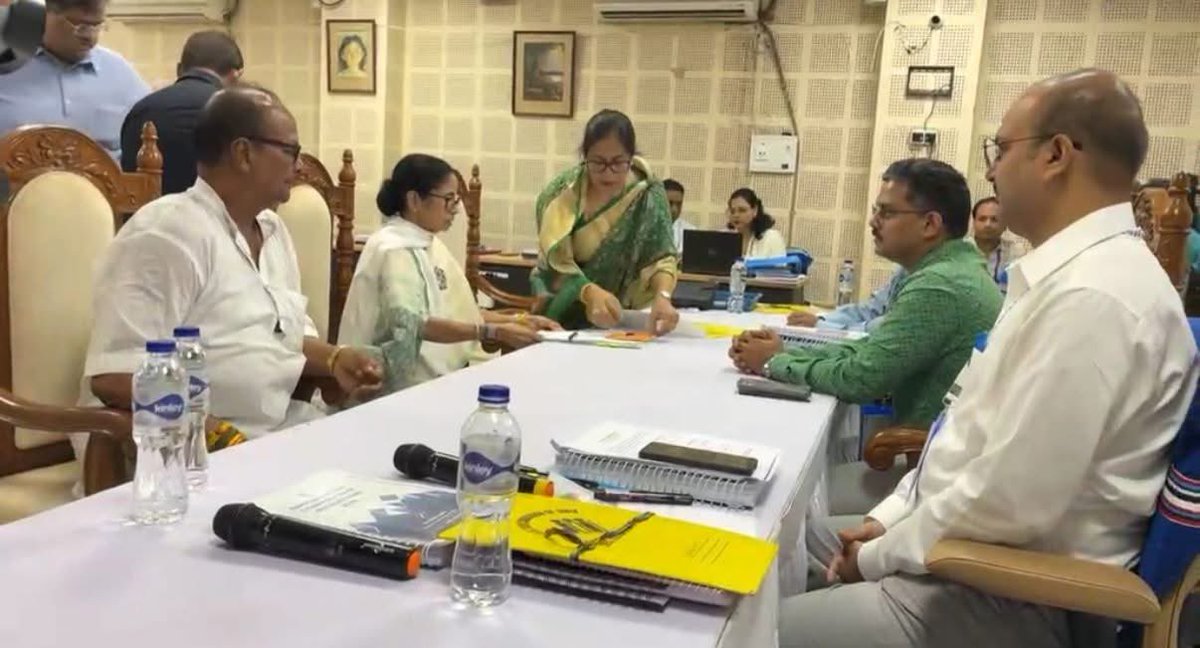
Bengal CM Mamata Banerjee filed nomination on Wednesday, reflecting more than four decades of uninterrupted political engagement — from grassroots activism to becoming one of India’s most influential regional leaders.
Born on January 5, 1955, in Kolkata, Banerjee grew up in a lower middle-class household. Following the early death of her father, she was raised by her mother in financially constrained circumstances. She completed her education at the University of Calcutta, earning degrees in History, Islamic History, Education, and Law. These formative experiences are often cited as shaping her political identity and emphasis on welfare-oriented governance.
Banerjee began her political career with the Indian National Congress in the 1970s, rising rapidly through its youth ranks. In 1984, she gained national prominence by defeating veteran Communist leader Somnath Chatterjee in the Jadavpur Lok Sabha constituency, becoming one of the youngest Members of Parliament in the country. During her tenure in Congress, she served multiple terms in Parliament and held Union ministerial roles, including Minister of State for Human Resource Development, Youth Affairs and Sports, and Women and Child Development. Her tenure was marked by an outspoken political style and frequent confrontations with opponents.
In 1998, she broke away to form the All India Trinamool Congress (TMC), positioning it as the principal opposition to the Left Front in West Bengal. She later joined the National Democratic Alliance and served as Railway Minister under Prime Minister Atal Bihari Vajpayee.
Banerjee served multiple terms as Railway Minister (1999–2001, 2009–2011), focusing on affordability and regional connectivity. Her tenure saw the introduction of new trains in underserved regions, improvements in passenger amenities, and initiatives such as low-cost travel schemes aimed at economically weaker sections.
Her rise in state politics was closely linked to her leadership in key land movements, particularly the Singur agitation (2006) and the Nandigram protests. These mobilisations, centred on land acquisition and industrialisation policies, consolidated her support among farmers and rural communities while weakening the long-standing Left Front government.
In 2011, Banerjee led the TMC to a decisive victory, ending 34 years of Left Front rule in West Bengal and becoming the state’s first woman Chief Minister. She has since retained power in the 2016 and 2021 Assembly elections, reinforcing her position as the dominant political force in the state.
As Chief Minister, she has introduced a wide range of welfare initiatives, including schemes focused on women’s financial support, education access, healthcare coverage, and rural infrastructure. Programmes such as Kanyashree, Swasthya Sathi, and Lakshmir Bhandar have been central to her governance model, which emphasises direct welfare delivery and social support.
Banerjee is known for a centralised leadership style, often holding key portfolios such as Home and Health, and maintaining close control over administrative functioning. Her political approach combines frequent public outreach, welfare-driven policymaking, and direct communication through rallies and social media.
Her tenure has also drawn criticism from opposition parties, including the Bharatiya Janata Party and Left groups. Allegations have ranged from political violence to concerns over dissent and law and order, all of which her government has consistently denied as politically motivated.
At the national level, Banerjee has emerged as a prominent opposition figure, attempting to forge alliances among non-BJP parties and positioning herself within broader opposition politics.
Known for her austere lifestyle, she is often seen in a simple white saree and sandals. Beyond politics, she is a published writer and painter. Supporters regard her as a leader with deep grassroots connections, while critics describe her approach as combative.
As she files her nomination once again, Mamata Banerjee remains central to West Bengal’s political landscape. With decades of experience, a strong party structure, and a committed voter base, her political trajectory continues to shape the state’s electoral future.
If you want, I can make it sharper for a newspaper front page or cut it down to a tighter 400–500 word version.